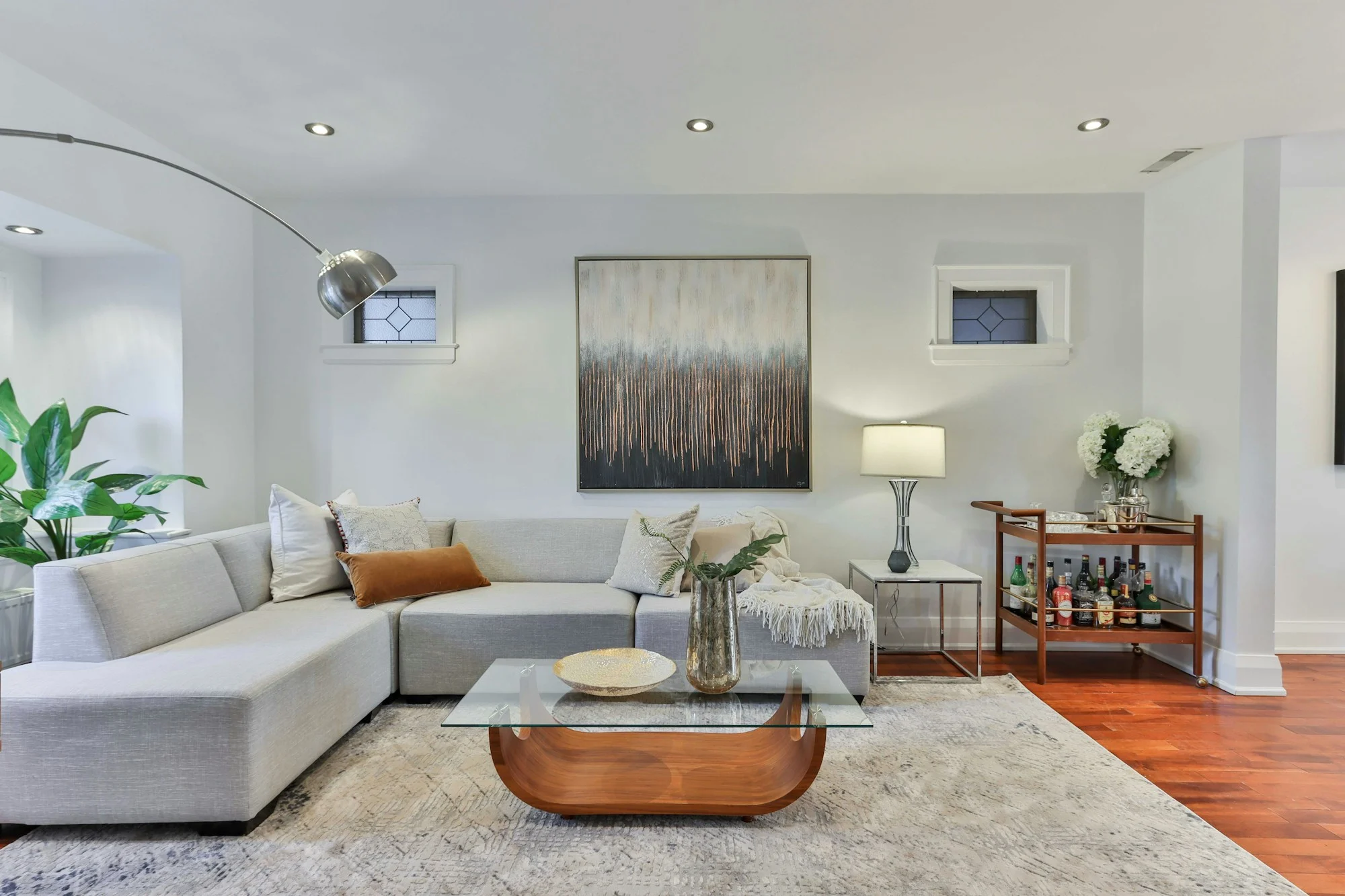
Match the big pieces to the wall. The Spruce says furniture that matches the wall color is less jarring and tends to blend with the space, giving the illusion of a bigger room, and contrasting colors tend to break up a space. Put your strong color in one small piece, and use furniture with visible legs so the floor shows underneath. That is designer convention, not a measured result.
Five conventions designers use
- Match the wall. The Spruce suggests coordinating wall and furniture colors. Shinesheets adds that a cream sofa against a warm white wall reads as part of the room, while a dark navy sofa against the same wall reads as a big heavy shape.
- Use tone-on-tone. The Spruce suggests colors in the same family, with tonal upholstery and drapery.
- Keep the strong color small. Shinesheets says to save stronger colors for small, easy-to-change things like a throw or a vase.
- Show the floor. The Spruce quotes designers on sofas and chairs elevated on legs, and Shinesheets lists a console with open space beneath and a nightstand on tapered feet.
- Let light pass. Shinesheets lists acrylic or glass side tables as lighter than solid dark wood ones, because light passes through clear pieces.
When the convention does not apply
These are conventions, and designers disagree. Homebuilding quotes a designer who says not to assume that a small room has to be painted white, and that a low-LRV color in good light can feel cocooning rather than cramped. The housing.info guide says a dark wall with bright white trim strongly outlines the room, while the same dark color carried across trim, doors and storage can feel seamless. So the rule underneath is continuity, not only lightness.
What LRV is, and what we do not have
LRV, or light reflectance value, is a paint measure. Benjamin Moore’s architect course describes it as a percentage from 0 for absolute black to 100 for perfectly reflective white, with the most absorbing black near 5 and an extremely reflective white near 90. Diamond Vogel calls an LRV above 50 lighter and below 50 darker. Paint makers publish LRV for their paints. We have not measured or published an LRV for our panel colors, and we do not publish RAL codes for the 14 standard colors, so we do not give either. Custom RAL colors are available on request.
Our 14 colors in five groups
Here is our own pairing, a design suggestion and not a published standard. The groups sort the 14 standard colors by how much they recede into a room.
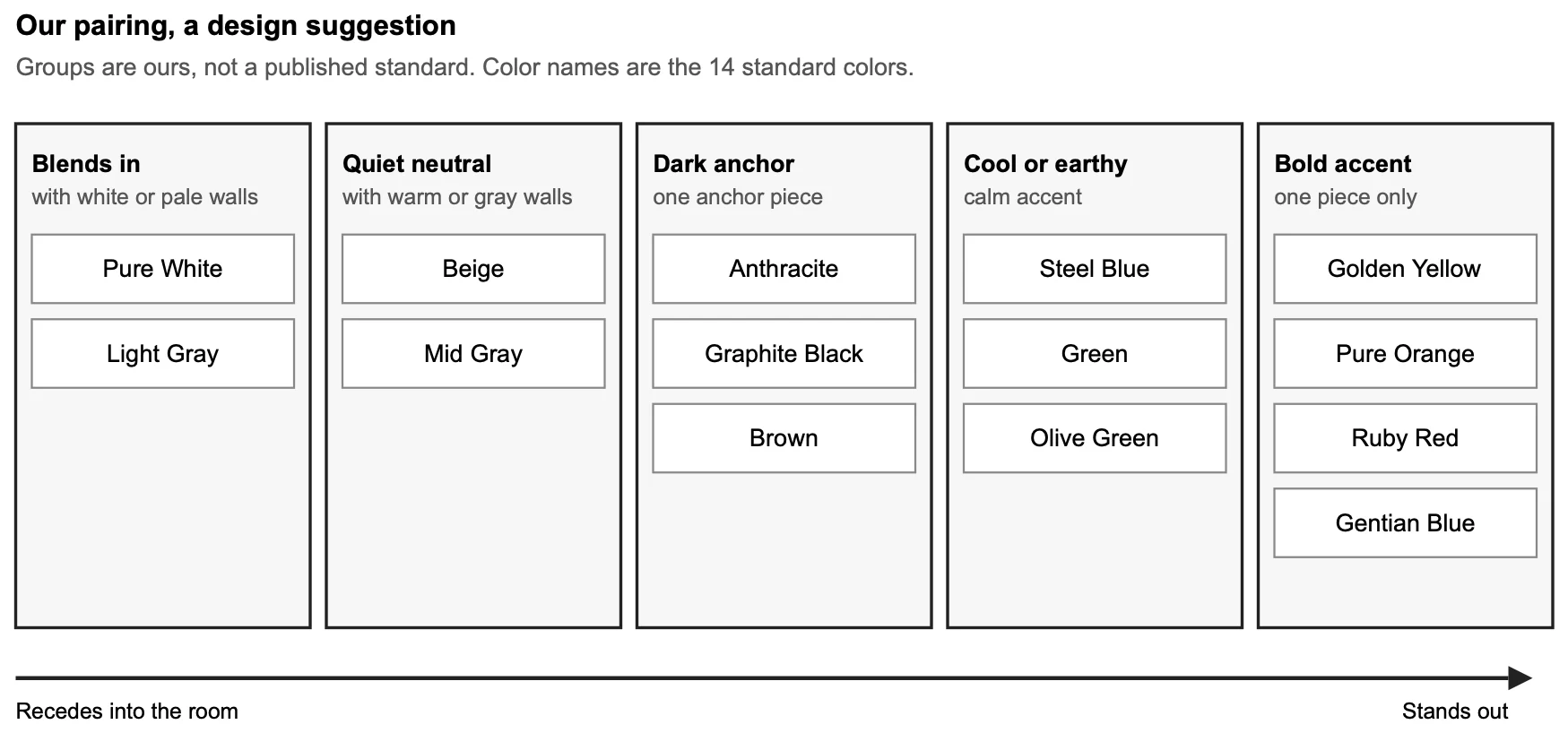
| Group | Colors | How to use it |
|---|---|---|
| Blends in with white or pale walls | Pure White, Light Gray | Closest to the Spruce idea of furniture that blends with a pale wall. |
| Quiet neutral with warm or gray walls | Beige, Mid Gray | A softer step away from the wall color on warm or gray walls. |
| Dark anchor, one piece | Anthracite, Graphite Black, Brown | One grounding piece, or a dark room carried through with continuity (housing.info). |
| Cool or earthy, a calm accent | Steel Blue, Green, Olive Green | The Spruce suggests soft blues and greens for a more open look. Ours are mid-tone, so keep them to one piece. |
| Bold accent, one piece only | Golden Yellow, Pure Orange, Ruby Red, Gentian Blue | One piece, in the spirit of Shinesheets: strong color in small, easy-to-change things. |
Check before you buy
- Look at each product page for its feet or legs before you count on visible floor underneath. The catalog data we keep does not list leg height.
- Look at paint samples and fabric swatches in the room’s light at different times of day, as a housinginfo.org guide suggests for paint.
- Use the configurator to see the colors on a unit before you pick one.
Fill-in checklist
| Question | Your answer |
|---|---|
| Wall color (name and LRV from the chip)? | |
| Which group will the largest piece belong to? | |
| Which one piece carries the strong color? | |
| Do the main pieces show floor underneath? | |
| Is there a glass or acrylic piece to let light pass? |
Frequently asked questions
What color furniture makes a small room look bigger?
The Spruce says pieces that match the wall color are less jarring and tend to blend with the space, giving the illusion of a bigger room. Pale neutrals such as white, cream and beige are its go-to shades. This is designer convention, not a measured result.
Does furniture on legs make a room feel bigger?
Several guides say yes. Furniture raised on slim legs lets you see the floor underneath, and Shinesheets says seeing more floor tells your brain the room is bigger. Check each piece’s real leg height before you count on it.
Should a small room always be painted white?
No. Homebuilding quotes a designer who says not to assume a small room has to be painted white, and housing.info says a deep color carried across walls, trim, doors and storage can work. Continuity matters as much as lightness.
What is LRV and does it apply to furniture?
LRV, or light reflectance value, is a paint measure from 0 for absolute black to 100 for pure white. It describes how much light a paint color reflects. We have no LRV published for our panel colors, so we do not give one.
Sources
- The Spruce, 11 easy ways to make a small room look bigger.
- The Spruce, 6 ways to make your home feel ten times larger, according to designers.
- Shinesheets, How to make a small room look bigger: 20 designer tricks.
- housing.info, How color, furniture and light can make small rooms feel bigger.
- housinginfo.org, Free guide to making small rooms feel bigger.
- Homebuilding, What is paint LRV.
- Benjamin Moore continuing education course, The science of visible light and its impact on paint specification (BNP Media).
- Diamond Vogel, Shedding light on the situation (LRV technical bulletin).
These are design conventions, not rules, and your room, light and taste decide the result.